
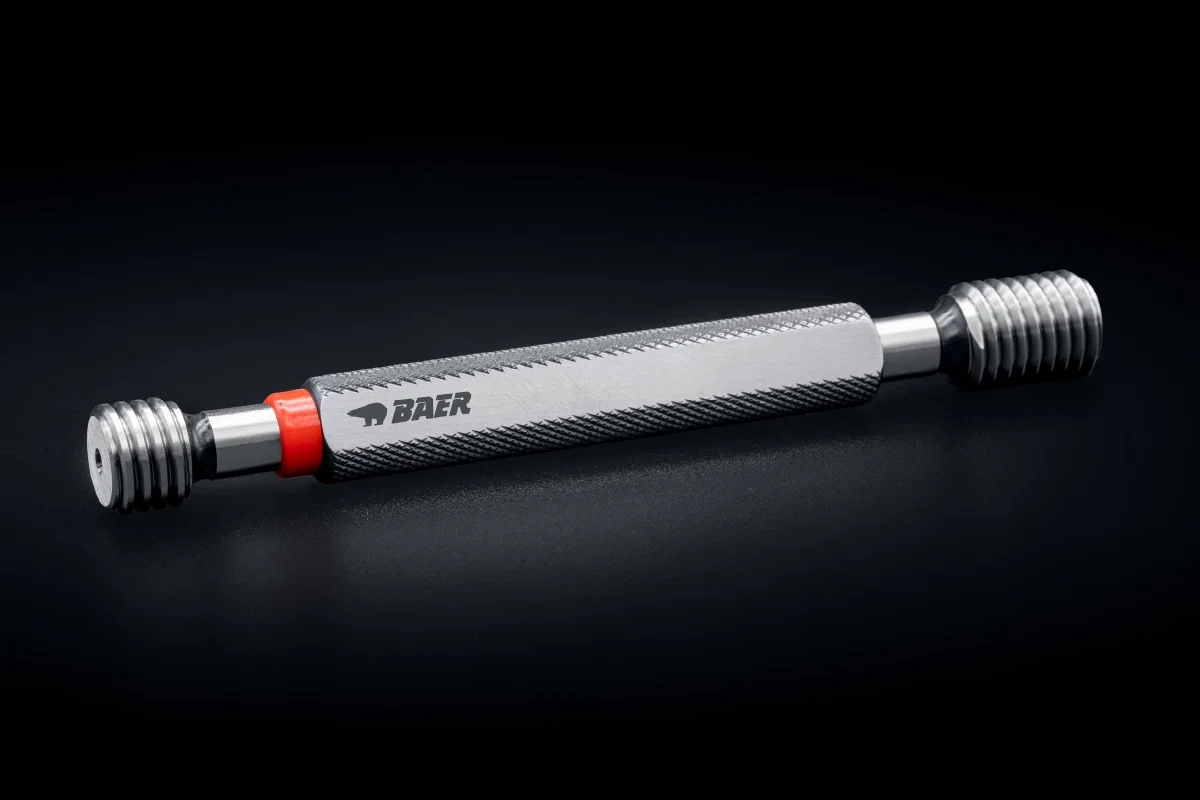
Thread Plug Gauge – What Is It and Who Needs One?
As a manufacturer of threading tools, we at BAER could easily tell you that you can never have enough tools and accessories. However, we value satisfied customers who can rely on us, which is why honest purchasing advice is important to us. Some products can be recommended to every DIY enthusiast and professional without hesitation. Others are only useful in certain situations, and some only in rare special cases. So which category does the thread plug gauge fall into?
The term thread plug gauge usually refers to a thread limit plug gauge, and this practical inspection tool is exactly what this article is about. You may have already seen the handle with a thread on each end and wondered whether it could help you with thread machining. If so, keep reading, because we will answer that question today. Do you need a thread plug gauge, and if so, what should you consider when using it?

Checking threads – Is it necessary?
A thread plug gauge is a highly precise measuring tool used in metalworking and quality assurance to check the dimensional accuracy and functionality of internal threads. In simple terms, it compares the actual condition of a cut thread with a defined target condition – do diameter, angle, and pitch match? It is important to note that gauge dimensions are standardized according to DIN ISO, for example metric threads according to DIN ISO 1502. This ensures legal certainty in case of discrepancies with customers.
In industrial environments or professional workshops, regular inspection of standard and fine threads is therefore advisable, both for legal protection and to ensure consistent quality in production. If a thread does not meet specifications, this becomes immediately apparent and the source of error can be identified.

But what about use in a home workshop? In private settings, checking with a thread gauge makes sense when high precision is important for your projects. The gauge helps determine whether a tap is worn and needs to be replaced or reground. This allows you to take corrective action before producing multiple threads that deviate from standard dimensions. In most cases, however, you will manage without a thread gauge.
Go/no-go sides on one handle – How a thread limit plug gauge is designed
The thread limit plug gauge is a special type among thread gauges. These are typically available in two versions: go or no-go plug gauges for checking internal threads and go or no-go ring gauges for checking external threads. This distinction exists because thread dimensions must be checked in both directions: is it not too large and is it not too small?

The thread limit plug gauge combines both the go and no-go gauges on a single handle. This is practical because you simply turn the inspection tool during use, and there is no risk of mixing up separate gauges. It also saves space and weight, which can be important for mobile use.

Thread plug gauges are made from hardened gauge steel to ensure high precision and durability. They are available for thread sizes ranging from 1 mm to 40 mm nominal diameter. The no-go side is marked with a red ring so you can immediately identify the correct orientation.
How to use a thread gauge
In principle, using a thread limit plug gauge does not differ from using any other thread gauge. The thread must be completely clean, free of chips, and dry before inspection. The check should also be carried out at a test temperature of approximately 20 °C. Only under proper conditions can you rely fully on the measurement result.
The go side of the gauge must screw easily and completely into the thread. The no-go side, however, must not engage more than a maximum of two turns, as this indicates that the thread is too large. If a thread is too small, it can still be reworked, but a thread that is too large must be rejected. This is why the terms go and no-go are used.

What to consider when buying – Key points
The most obvious point first: make sure that the product is actually a limit plug gauge before adding it to your cart. Otherwise, you would need to purchase go and no-go gauges separately – and with only one gauge, you cannot fully verify thread conformity.
Gauges are manufactured for specific thread standards, so ensure that you select the correct gauge for the thread you are using. Also note that external threads can be checked as well, but this requires ring gauges.
When it comes to precision, tolerance plays an important role. Thread gauges are assigned to tolerance classes, and some standards allow more clearance, for example to accommodate coatings. Choose a tool that matches your specific application.
Well equipped with a thread plug gauge from the BAER range
In the BAER online shop, you will find a comprehensive range of thread gauges for many commonly used thread standards. We offer plug gauges, ring gauges, and of course practical thread limit plug gauges – all in the well-known BAER quality at a fair price. If you require calibration for your gauges, we are happy to provide this service in-house. Simply add the “calibration” item to your order during checkout.

Do you need further advice or have questions about this complex topic? We are happy to help. Contact us by phone or via our contact form.