
Solid Carbide Drill
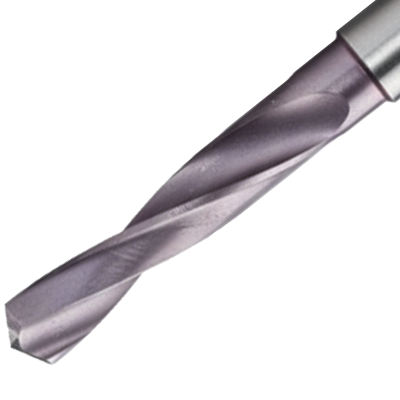
A solid carbide drill is a high-performance tool for producing precise holes in metallic and hard-to-machine materials. Unlike HSS or HSSE drills, it consists entirely of carbide.
Properties and advantages:
- High hardness: Significantly longer tool life than HSS or HSSE drills.
- Temperature resistance: Remains dimensionally stable and sharp at over 800 °C.
- Precise dimensional accuracy: Ideal for tight tolerances and high-precision holes.
- High cutting speed: Particularly suitable for CNC machines and automated production.
Applications:
Used wherever high cutting speeds, long tool life and precise drilling results are required – e.g. stainless steel, titanium, cast iron and fibre-reinforced plastics.
Disadvantages:
Due to their brittleness, solid carbide drills are sensitive to impacts and vibrations and are less suitable for hand-guided applications. Acquisition costs are higher than for HSS drills, but this is usually offset by the longer tool life.