
Blind Hole
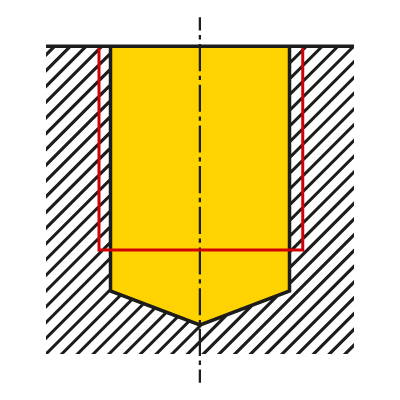
A blind hole is a drilled hole that does not pass completely through the workpiece but ends within the material – like a pocket. There is only an entry, but no exit on the other side.
When tapping threads, this means:
- The tap must be guided into the material without passing through it.
- The chips produced accumulate at the bottom of the blind hole and cannot simply fall out from the back.
- Special taps with spiral flutes are therefore used for blind holes to convey chips upwards and out.
Practical example:
When a screw needs to be fixed "invisibly" in a component, a blind hole is often used. The screw ends within the material and does not protrude on the reverse side – e.g. in engine parts, housings or machine components.