
Thread
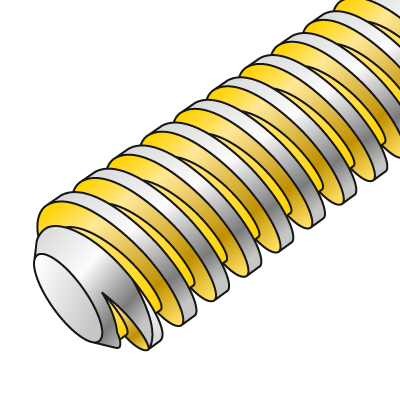
A thread is a helical groove on a cylinder or in a bore. It is formed when a profiled line – similar to a diagonal groove – is wound around the cylinder.
Threads have a clear function:
They connect components firmly together or enable precise movements (e.g. in screws, nuts or lead screws).
The most important characteristics of a thread are:
- Profile form: the basic shape of the groove, e.g. triangular, trapezoidal or round
- Pitch: the distance a screw travels per revolution in the axial direction
- Number of starts: single- or multi-start (several parallel thread starts)
- Handedness: right- or left-hand (right-hand screws are standard in everyday use)
Common thread types include:
- Metric coarse thread (ISO thread) – standard for screws and nuts
- Metric fine thread – smaller pitch, for precise or strong connections
- Trapezoidal thread – suitable for motion and force transmission, e.g. in vices
- Round thread – robust against damage, e.g. in light bulb fittings
- Pipe thread – for leak-proof connections in pipelines